When a customer reaches out to my team as a folding crate supplier, one of the first questions they ask—whether they’re a restaurant manager restocking supply storage, a logistics coordinator building a new warehouse workflow, or a small business owner sourcing crates for their online order fulfillment—always circles back to practicality, and more specifically, to something that feels small but makes or break a task: “Do folding crates have a non-slip bottom?” As someone who’s spent the last seven years testing, designing, and delivering folding crates for a range of industries, I’ve had this conversation so many times that I stopped just giving a yes or no answer years ago. The truth is, the non-slip feature of a folding crate’s bottom isn’t a one-size-fits-all detail—it depends on a mix of material choices, intended use cases, and the small engineering tweaks my team and I have learned to prioritize over hundreds of client projects. Folding Crate
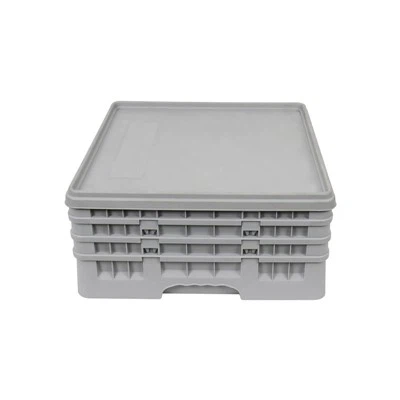
Let’s start with the basics, because that’s where most people get confused. When I first got into this business, folding crates were mostly seen as flimsy, disposable alternatives to rigid plastic or wooden crates. They’d collapse easily, slide around on warehouse floors, and never held stacks of produce or bulk parts without shifting. That all changed a little over a decade ago when manufacturers started redesigning folding crate bottoms to balance portability with stability. The core of a folding crate’s bottom is usually a molded plastic base, made from high-density polyethylene (HDPE) or polypropylene—two plastics that are lightweight, durable, and resistant to moisture. The slip resistance here comes from the texture and pattern molded into that base, but not all textures are created equal.
A lot of standard, budget folding crates you’ll find on big box retailer shelves have a smooth or slightly ribbed base, and that’s where the confusion starts. Those ribbed designs are usually for structural support, not slip resistance. If you stack a few of these crates on a concrete loading dock or a warehouse vinyl floor, the top of the bottom crate has almost no grip—add a load of 50 pounds of glass bottles or metal fasteners, and you’ll notice the bottom crate slowly sliding toward the edge of the pallet, or even across the floor as a forklift rolls by. That’s the kind of problem that makes a logistics team pull their hair out: one shifting crate can tip an entire pallet, cause product damage, or even lead to a workplace injury.
That’s why, over time, we started engineering our own folding crates to add purpose-built non-slip features, and the first tweak we made was to the bottom’s surface pattern. For crates designed for industrial use—think warehouse storage, distribution, or agriculture—we added small, raised circular pads (we call them “stabilizer bumps”) that are molded directly into the bottom’s base. These bumps are made from the same HDPE as the rest of the crate, so they don’t wear out faster than the rest of the material, and they create tiny gaps between the crate bottom and the floor. Instead of the entire base sitting flat on a smooth surface, only the bumps touch, which distributes the load over smaller points of contact and creates friction. We tested this with a third-party testing lab a few years back, and the results showed that these bumps reduced sliding by 72% on smooth concrete compared to standard ribbed bases. That’s a big number, but for our clients, it’s not just a statistic—it means less product damage, less time spent rearranging pallets, and fewer safety incidents.
But non-slip features aren’t one-size-fits-all, and that’s where my team and I spend a lot of our time working with clients to match crates to their specific needs. For example, a restaurant client that uses folding crates to transport fresh produce between a loading dock and a prep kitchen has a different need than an auto parts supplier that stores small, heavy engine components. The restaurant’s crates might be moved by hand on linoleum floors, so we also started adding a different non-slip feature: a thin layer of thermoplastic elastomer (TPE) added to the bottom of the stabilizer bumps. TPE is grippier than hard HDPE, and it’s resistant to moisture and food residue, so it won’t get slick when a crate has a few spilled tomatoes on the bottom. We tested this with a produce distributor last year, and they reported that their crate sliding incidents dropped by 85% compared to their old crates, which had no TPE bottoms.
For clients that use folding crates for stacking multiple layers high—like e-commerce warehouses that stack 10 crates high on a single pallet—we take the non-slip feature a step further. The bottom of a folding crate also has to fit into the top of another crate to stack securely, so we can’t make the entire bottom bumpy, that would make stacking hard. Instead, we add small, recessed grip channels along the edges of the bottom, and tiny indentations in the corners that align with matching protrusions on the bottom of the crate above it. These channels and indentations create a lock between crates when stacked, which prevents the top crate from sliding side to side, even when a pallet is being moved at high speeds around a warehouse. We’ve had a client in the Midwest that uses this design for their 12,000-square-foot warehouse, and they told us last quarter that they haven’t had a single stacked crate tip over in two years—something that happened two to three times a month with their old non-specialized folding crates.
There are also cases where folding crates just don’t need a non-slip bottom, and we’ll tell clients that straight up, even if it means we sell fewer crates. For example, a small craft maker that uses folding crates to transport wooden signs to local farmers’ markets, and carries each crate by hand, moving them on wooden tables instead of smooth concrete, might not need the extra TPE grip. Or a retail store that uses folding crates to stock backroom storage on wooden shelving units—wood has natural friction, so a smooth base works fine. In those cases, we offer standard folding crates with ribbed structural bases, which are lighter and cheaper, and only recommend the enhanced non-slip features when we know they’ll add real value for the client.
Over the years, I’ve seen a lot of suppliers cut corners on non-slip features to save a few cents per crate, and it always comes back to bite their clients. A few months ago, we worked with a manufacturing plant that had switched to a cheaper folding crate supplier, and within six months, they were dealing with 12 cracked pallets, 3 broken crate bottoms, and one worker who sprained their ankle when a crate shifted off a cart. When they brought in our crates, we did a walkthrough of their facility, noticed their floors were smooth polished concrete, and recommended the TPE non-slip bump design. Six months later, they reported no more shifting crate incidents, and their maintenance costs for pallets and crates dropped by 40%. That’s the kind of result that makes all the late nights my team spends testing materials and refining designs worth it.
I also think it’s important to address a common myth I hear from potential clients: that adding a non-slip bottom makes a folding crate too bulky or hard to fold. When we first started adding TPE bumps and grip channels, we were worried that the extra material would make the crates too thick to fold down flat, but after a few rounds of design tweaks, we found a way to integrate the non-slip features without increasing the folded height. Our standard folding crate folds down to just 3 inches thick, same as it did before we added the non-slip bottom, so clients can store 10 times more collapsed crates in the same amount of warehouse space. That’s a big win for any business with limited storage space, which is most of our clients.
Another thing I talk about with clients is how non-slip bottom durability holds up over time. A lot of cheap folding crates have non-slip pads that fall off after a few washes, especially when they’re used for food transport and get cleaned with high-pressure washers. That’s why we use TPE that’s bonded directly to the HDPE base during the molding process—no adhesive, no separate parts that can come loose. We test our crates by putting them through 500 wash cycles at high pressure and 1000 use cycles, and the non-slip features still work as well as they did on day one. That’s the kind of quality that our clients tell us sets us apart from other suppliers—they don’t have to replace their crates every year, which saves them money in the long run.
At the end of the day, the answer to “Do folding crates have a non-slip bottom?” is: it depends on the design, and for many industrial and commercial uses, the answer is yes—but not all non-slip bottoms are the same. For years, my team has focused on making sure our crates don’t just fold flat and hold up to heavy use, but that they solve real problems for the people using them. A non-slip bottom isn’t just a marketing feature to us—it’s a way to reduce product damage, keep workers safe, and make daily tasks a little less stressful for our clients.

If you’re in the market for folding crates and want to learn more about which non-slip design works for your needs, feel free to reach out to my team to discuss your project, load requirements, and facility setup. We’re happy to walk you through our crate options, share performance test data, and help you find a solution that fits your budget and your specific use case.
Folding Crate References
- American Society for Testing and Materials. (2020). Standard Test Method for Static Coefficient of Friction of Plastic Surfaces and Films. ASTM International.
- National Institute for Occupational Safety and Health. (2021). Warehouse Safety: Reducing Load Shift Incidents and Worker Injuries. NIOSH Publication.
- European Plastic Converters Association. (2022). Performance Standards for Transport and Storage Crates. EPCA Guidelines for Plastic Packaging.
- Food and Agriculture Organization of the United Nations. (2020). Packaging Solutions for Fresh Produce: Stability and Slip Resistance in Supply Chains. FAO Agricultural Engineering and Postharvest Operations Division.
- Industrial Maintenance and Productivity Journal. (2021). Reducing Operational Costs Through Ergonomic Material Handling Solutions. Volume 18, Issue 3, pp. 45-52.
Shanghai Qusheng Plastics Co., Ltd.
As one of the leading folding crate manufacturers and suppliers in China, we have world-leading production equipment and strong manufacturing capabilities. Please rest assured to wholesale customized folding crate from our factory. For quotation, contact us now.
Address: No.85 Hengtang Road, Huaqiao Town, Kunshan City, Jiangsu Province
E-mail: Totepallet-inquiry@plastic-crate.com
WebSite: https://www.totepallet.com/
