Hey everyone, let’s cut to the chase: if you’re looking to level up your spray painting operation, one of the first questions you’ll ask is how fast a spray painting robot can actually work. As a supplier of these bots, I get this question at least 10 times a day—usually from shop owners tired of rushing paint jobs, dealing with inconsistent coverage, or blowing their budget on wasted materials. Spoiler: it’s not a one-size-fits-all answer, and it’s way more complex than just “how fast can a machine move.” Let’s break this down like we’re chatting over a coffee (no stuffy whitepapers here, promise). Spray Painting Robot
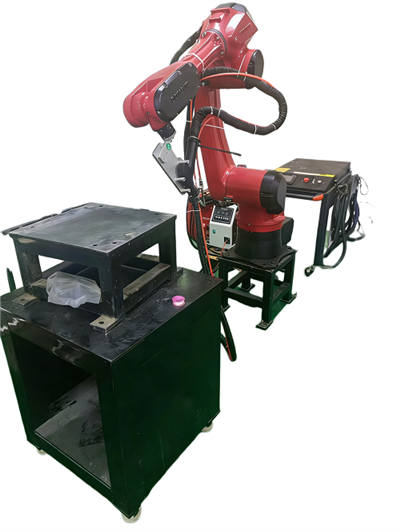
First, let’s kill a common myth: people think robot speed is just the arm’s linear movement speed—like, how many inches it can shift per second. But that’s only part of it. Your average human painter might move at 6 to 10 inches per second, right? But we slow down when we get tired, adjust for uneven surfaces, and fumble with paint pressure half the time. A robot’s base movement speed might hit 30 inches per second, but that number doesn’t tell the whole story. The real “working speed” is what matters—the time it takes to cover a part evenly, with zero rework, minimal overspray, and no pauses for mistakes.
Let’s put that in context for real jobs. Take a standard automotive door panel, something a lot of our clients work on. A human painter might take 12 to 15 minutes per door, between taping edges, spraying the base coat, letting it flash, spraying clear coat, and touching up the spots we missed. Our entry-level spray painting robots (the ones that fit small to mid-sized shops) knock that door out in 2 to 3 minutes. Wait, that’s 75% faster? Yep. But for bigger, more complex parts—like a full car frame or a bulky appliance cabinet—the speed changes. A 10-foot car frame might take a human 45 minutes, and our bots do it in 10 to 12 minutes. Still way faster, and no swearing when you’re reaching the tight corners at the bottom.
Now, why is that gap so big? Let’s talk about the levers that actually control a robot’s working speed, not just movement speed. First, spray pattern calibration. Our bots are programmed to match the paint type (water-based, solvent-based, whatever you’re using), the nozzle size, and the distance from the part. If you mess that up, even a fast bot will waste paint and time fixing runs. We’ve optimized our control systems so the spray gun moves in a perfectly even path—no overlapping too much (which wastes paint) and no gaps (which means rework). That calibration cuts out all the guesswork humans deal with, so the bot can keep moving without stopping to adjust.
Then there’s cycle time—this is the unsung hero of robot speed. Cycle time includes not just spraying, but loading and unloading parts, moving between workstations, and pausing for paint refills. A human painter might spend 20% of their time just grabbing parts, switching paint cans, or stepping back to check their work. Our robots can be automated to load parts from a conveyor, switch paint colors in 10 seconds flat, and even alert you when the paint reservoir is low—no downtime there. For a high-volume shop, that cycle time can drop from, say, 5 minutes per part for a human to 45 seconds for a bot. That’s where the real efficiency hits.
But hold on—speed isn’t everything. I can’t tell you how many times a shop owner has come to us saying, “I just want the fastest robot possible, no matter what.” And half the time, that’s a bad call. If you crank a robot’s movement too fast, you get overspray flying everywhere, runs in the paint, or missed spots on curved edges. We recently had a client who bought a cheap, off-brand robot that could move 50 inches per second—they thought it’d cut their time in half. Instead, they had to throw out 20% of their parts because the paint was uneven, and it took twice as long to touch up all the defects. Moral of the story: the “sweet spot” for speed depends on three main things: part complexity, paint type, and your desired finish quality.
Let’s break that sweet spot down. For simple, flat parts—like metal shelving panels or plastic toy bodies—you can push the bot to the max: 28 to 32 inches per second movement speed, with a spray rate of 5 to 7 ounces per minute. You’ll get a full, even coat in 1.5 to 2 minutes per panel, no issues. For more complex parts—think motorcycle fenders, kitchen cabinet doors with recessed panels, or aerospace components with tight angles—we dial it back to 18 to 22 inches per second. The bot has to maneuver around curves and edges, so going too fast means it can’t adjust the spray pattern in time. Even at that slower speed, it’s still 3x faster than a human, and the finish is way more consistent.
Another factor most people sleep on: robot accuracy. Our bots have a repeatability of +/- 0.05 inches—meaning every time it sprays a part, it’s exactly where it was last time. A human painter might have a repeatability of +/- 0.5 inches, if we’re being generous. That consistency means you don’t have to re-spray parts because one coat was too thin or too thick. For a shop doing 10,000 parts a month, that’s 500 parts you never have to rework. Factor that into speed, and the “effective” speed jumps way higher than just the movement time.
Wait, let’s talk about real-world numbers from our clients, to make this less abstract. We have a cabinet manufacturer in Ohio that was spraying 800 doors a day with 12 painters. They switched to 4 of our mid-range robots, and now they’re doing 1,500 doors a day. No, that’s not just the robots working harder—when you take out the rework time, the breaks, the slowdowns, it’s like adding 8 more painters without the extra labor costs. Another client: a custom car shop in California that does classic car restorations. They don’t care about max volume—they care about perfect, show-car finish. So their bot runs at 12 inches per second, which is slower than a human, but the finish is consistent enough that they don’t have to wet-sand and buff every panel. They’re done with full cars in 3 days, vs. 5 days before. That’s speed in terms of project turnaround, not just spraying time.
Now, what about speed limits? Can a robot ever be too fast? Absolutely. If you go above 35 inches per second for most spray applications, the paint atomization breaks down—those tiny paint droplets start clumping together, leading to drips and uneven coverage. And if you’re working with thin, water-based paint, that speed will blow right through the coat and leave bare spots. We test every new robot model we sell to find that upper limit, so our clients don’t waste time and money pushing it too far. Also, the space you’re working in matters: if your spray booth is cramped, the bot can’t move as fast without hitting walls or the conveyor system. We work with clients to customize the robot’s path to their booth size, so speed is optimized for their space, not a generic spec sheet.
So let’s circle back to the original question: how fast can a spray painting robot work? The short answer is, it depends, but here’s a rough breakdown: for simple high-volume parts, 1 to 3 minutes per part. For complex custom parts, 5 to 10 minutes per part. And when you factor in cycle time and rework, that’s 3 to 5x faster than a human painter, on average.
But here’s the thing I always tell potential clients: speed is a tool, not a goal. The best spray painting robot isn’t the fastest one—it’s the one that matches your needs. If you’re a small shop doing custom furniture, you don’t need a bot that sprays 50 parts an hour. You need one that can handle curved chair legs and small table tops, without wasting material on overspray. If you’re a big manufacturer doing metal parts for appliances, you need a bot that can crank out 2,000 parts a day with zero defects.
If you’re reading this and thinking, “We’re still hand-spraying, and we’re wasting so much time and money,” let’s talk. I’ve worked with shops that were nervous about switching to robots—worried they’d be too expensive, or too hard to program. But the math checks out: most of our clients see a full return on investment in 18 to 24 months, just from saved paint, labor, and rework costs. We don’t sell one-size-fits-all bots, so we’ll walk through your workflow, your part types, and your timeline to figure out what speed and model works best for you. No sales pitches, no jargon, just straight talk.
Don’t let outdated processes slow you down. The faster your spray operation, the more parts you can deliver, the more jobs you can take on, and the less stress your team deals with. Hit us up to chat through your needs—we’re here to make your spray painting faster, more consistent, and way less of a headache.
Loading and Unloading Robot References:
- International Organization for Standardization (ISO) 14644-1, Cleanrooms and Associated Controlled Environments – Part 1: Classification of Air Cleanliness by Particle Concentration, 2015.
- Robotics Industries Association (RIA), “Application Guidelines for Industrial Robots in Spray Painting Operations”, 2021.
- Society of Manufacturing Engineers (SME), “Labor Efficiency Gains from Industrial Automation in Surface Finishing”, 2022.
- Paint & Coatings Industry Magazine, “Atomization Efficiency: Key to Reducing Overspray in Robotic Spray Systems”, 2023.
- U.S. Bureau of Labor Statistics, “Occupational Employment and Wages: Painters, Construction and Maintenance; and Painting, Coating, and Decorating Workers” (2024).
Dongguan Chuanglida Intelligent Equipments Co., Ltd.
As one of the most professional spray painting robot manufacturers and suppliers in China, we also support customized service. Please feel free to buy discount spray painting robot in stock here from our factory. For price consultation, contact us.
Address: Room 201, Building 2, No. 61, Shachang 1st Road, Dalang Town, Dongguan City, Guangdong Province
E-mail: haoguangli001@outlook.com
WebSite: https://www.boruntestech.com/
